
Why Call Transcript Redaction Is Critical for Your Business (And How to Do It Right)
You've just received an email. A customer service team needs to share a call transcript with their training department. The transcript contains everything: the customer's name, account number, email, phone, and the rep's notes on the account history. One person replies all with the transcript link. Three departments now have access to sensitive customer data.
This scenario plays out in contact centers daily. And it's exactly why call transcript redaction isn't just a nice-to-have, it's a business necessity.
The core issue: Every unredacted transcript is a privacy breach waiting to happen. Share it carelessly, and you're exposing customer data to multiple people. Get it on Slack, email, a shared drive, or a third-party analytics platform without redaction, and your compliance risk skyrockets.
The Hidden Risk of Unredacted Transcripts
Here's what most teams don't realize: sharing unredacted call transcripts is a data exposure waiting to happen. Call recordings capture deeply personal information. Phone numbers, account details, medical information, payment card data, and more all end up in those transcripts.
When you share a transcript with training teams, quality assurance, analytics vendors, or third-party AI services, you're broadcasting that data to anyone who touches it. Accidentally leave it in an email thread? Now it's in someone's backup. Copy it to Slack? Searchable forever. Export it to a vendor's portal without redaction? You've just handed them access to customer data.
The problem compounds across thousands of calls. Every unredacted transcript is another vector for exposure. At 100 calls daily, that's 2,000 unredacted transcripts per month, each containing names, phone numbers, and account details of real customers.
Real-World Consequences
Consider what happens after exposure:
- Data breach notification: You're required to notify customers within 30-72 hours, depending on jurisdiction
- Regulatory fines: GDPR fines up to 4% of annual revenue, CCPA penalties up to $7,500 per violation
- Reputational damage: One news story about your data leak shapes customer perception for years
- Remediation costs: Credit monitoring, incident response, legal review resulting in easily six figures
- Operational disruption: Your team spends weeks managing the breach instead of serving customers
Compare this to the cost of a redaction process: a few hours to implement, seconds per transcript to execute. The ROI is staggering.
What Exactly Gets Exposed in Unredacted Transcripts?
Let's look at a real (anonymized) example of what lives in an unredacted call transcript:
Agent: Good morning, thank you for calling Customer Support.
       Can I have your account number please?

Customer: Sure, it's ACC-4892156. My name is Jennifer Miller.

Agent: Thank you, Jennifer. I see your account here.
       Last payment of $4,532.18 came through on October 15th.

Customer: Right. I'm calling about that charge.
          Can you send me to billing? My number is 555-0147.

Agent: Of course. Before I transfer you,
       I'll note your account with your SSN for security verification.
       I see you have 123-45-6789 on file.

Customer: That's correct. Also, my email is jennifer.miller@example.com
          in case you need to follow up.

Agent: Perfect, transferring you now.
What's exposed in this short transcript?
- Full name: Jennifer Miller
- Account number: ACC-4892156
- Phone number: 555-0147
- Email: jennifer.miller@example.com
- Social Security number: 123-45-6789
- Recent payment amount: $4,532.18
- Payment date: October 15th
This is enough information to commit identity fraud, contact the customer directly, or impersonate them in customer service calls. If this transcript is shared with 10 people, 10 people have Jennifer's full profile.
Compliance Isn't Optional Anymore
Regulations aren't ambiguous about this. They're getting stricter every year.
GDPR (EU, UK, other jurisdictions): Fines up to 4% of annual revenue or 20 million euros (whichever is higher) for data protection failures. GDPR requires data minimization: process only the personal data you need, keep it only as long as necessary, and delete it when you're done.
CCPA (California): Consumers have the right to know what data you have, request deletion, and opt out of sale. If you're holding unredacted transcripts indefinitely without documented business reason, you're likely violating CCPA. Penalties can range from $500 to $7,500 per violation for intentional violations.
TCPA (US telecommunications): Imposes strict rules on call recording consent and handling. Record calls without consent, or share recordings without proper safeguards, and you're liable for damages ($500-$1,500 per call) and penalties ($5,000-$15,000 per call) for intentional violations.
HIPAA (healthcare): If your call center handles any patient information, PHI (Protected Health Information) is subject to strict rules. Unredacted medical records, diagnoses, or patient identifiers are massive liability. Penalties can range from $100 to $50,000 per violation for intentional violations.
Redacting transcripts before storage, sharing, or third-party access isn't optional. It's required. And regulators audit this.
What Should You Redact? A Complete Breakdown
The obvious stuff: names, email addresses, phone numbers. But there's more. Many teams miss payment card data, account numbers, medical information, and identification numbers.
Here's what should always be redacted:
Personally Identifiable Information (PII)
- Full names: John Smith, Jane Doe
- Email addresses: john@example.com, jane.doe@company.org
- Phone numbers: 555-0147, (555) 123-4567, +1-555-0100
- Home addresses: 123 Main St, Anytown, CA 12345
- Social Security numbers: 123-45-6789
- Driver's license numbers: D1234567
- Passport numbers: AB123456
Payment and Financial Data
- Credit card numbers: 4532 1488 0343 6467 (all formats and spacing variations)
- Bank account numbers: ACME-987654321
- Routing numbers: 011000015 (9-digit bank routing)
- PayPal or payment IDs: customer_12345
Protected Health Information (PHI) - If Applicable
- Medical record numbers: MRN-456789
- Diagnosis codes: E11 (Type 2 diabetes), J45 (Asthma)
- Medication names: Metformin, Lisinopril
- Healthcare provider names: Dr. Sarah Johnson
- Patient identifiers: Patient ID: PT-001
Technical Identifiers
- IP addresses: 192.168.1.1
- Device IDs: IMEI-357419405269855
- User IDs: USER_12345
- API keys or credentials: (always redact)
Other Sensitive Data
- Account numbers: ACC-4892156, Account #987654
- Customer/Order IDs: if combined with other PII
- Sensitive dates: Dates of birth, when combined with other data
Pattern-based detection catches variations and formatting that manual find-and-replace misses. A credit card might show as:
4532 1488 0343 6467(spaces)4532-1488-0343-6467(dashes)4532.1488.0343.6467(dots)4532144803436467(no separator)
Manual redaction catches the first one. Automated pattern matching with validation catches all variations.
How Automated Redaction Works: The FoneSwift Redactor Example
Let's walk through how modern redaction tools work, using FoneSwift's Call Transcript Redactor as an example.
Step 1: Pattern Detection
The tool scans the transcript against multiple regex patterns simultaneously:
PATTERNS:
✓ Email pattern: \b[A-Za-z0-9._%+-]+@[A-Za-z0-9.-]+\.[A-Z|a-z]{2,}\b
✓ Phone pattern: \b\(?([0-9]{3})\)?[-.\s]?([0-9]{3})[-.\s]?([0-9]{4})\b
✓ SSN pattern: \b([0-9]{3}-[0-9]{2}-[0-9]{4})\b
✓ Credit card pattern: \b(?:\d[ -]*?){13,19}\b
✓ Account pattern: (?:account|ACC)[\s:]*([A-Z0-9]{6,20})\b
For our example transcript:
Input: "My number is 555-0147 and email is jennifer.miller@example.com"

Matches Found:
✓ Phone: 555-0147
✓ Email: jennifer.miller@example.com
Step 2: Validation
Not every pattern match is real PII. The tool validates:
- Phone number: Does the area code exist? Is the length correct? (Valid: 555 area code exists)
- Email: Does it have @ and a valid domain? (Valid: example.com is standard test domain)
- Credit card: Does it pass the Luhn check? (Most valid cards do)
- SSN: Excludes test patterns like 000-00-0000 and 666-XX-XXXX
This prevents false positives (redacting text that isn't actually PII).
Step 3: Redaction
Matching, validated PII is replaced with clear redaction tags:
Input: "Jennifer Miller called at 555-0147. Email: jennifer.miller@example.com"

Output: "[NAME_REDACTED] called at [PHONE_REDACTED].
         Email: [EMAIL_REDACTED]"
The redacted version is readable and preserves context while removing sensitive data.
Step 4: Summary Report
The tool displays what was found and redacted:
REDACTION SUMMARY
✓ Names: 1 item removed
  Examples: Jennifer Miller

✓ Phone Numbers: 1 item removed
  Examples: 555-0147

✓ Email Addresses: 1 item removed
  Examples: jennifer.miller@example.com

Total Items Redacted: 3
This gives you confidence that important patterns were caught.
Real Example: Redacting Our Sample Transcript
Here's the transcript from earlier, before and after redaction using pattern-based detection:
BEFORE (Unredacted):
Agent: Good morning, thank you for calling Customer Support.
       Can I have your account number please?

Customer: Sure, it's ACC-4892156. My name is Jennifer Miller.

Agent: Thank you, Jennifer. I see your account here.
       Last payment of $4,532.18 came through on October 15th.

Customer: Right. I'm calling about that charge.
          Can you send me to billing? My number is 555-0147.

Agent: Of course. Before I transfer you,
       I'll note your account with your SSN for security verification.
       I see you have 123-45-6789 on file.

Customer: That's correct. Also, my email is jennifer.miller@example.com
          in case you need to follow up.

Agent: Perfect, transferring you now.
AFTER (Redacted):
Agent: Good morning, thank you for calling Customer Support.
       Can I have your account number please?

Customer: Sure, it's [ACCOUNT_REDACTED]. My name is [NAME_REDACTED].

Agent: Thank you, [NAME_REDACTED]. I see your account here.
       Last payment of $4,532.18 came through on October 15th.

Customer: Right. I'm calling about that charge.
          Can you send me to billing? My number is [PHONE_REDACTED].

Agent: Of course. Before I transfer you,
       I'll note your account with your SSN for security verification.
       I see you have [SSN_REDACTED] on file.

Customer: That's correct. Also, my email is [EMAIL_REDACTED]
          in case you need to follow up.

Agent: Perfect, transferring you now.
Redaction Summary:
- Account numbers: 1
- Names: 2
- Phone numbers: 1
- Social Security numbers: 1
- Email addresses: 1
- Total PII items removed: 6
This transcript is now safe to share with training teams, QA managers, or external analytics tools. The call context is preserved, but sensitive data is gone.
The Redaction Workflow That Works
Step one: Capture transcripts as they're generated. Don't wait until you need to share. Build redaction into your process early. When a call ends and transcription completes, redact immediately before storing or sharing.
Step two: Use intelligent redaction, not manual search-and-replace. Intelligent tools understand context. They know that "Mike" in a sentence is a name, but "mike" (lowercase) in a microphone context might not be. They catch formatted data, abbreviations, and patterns humans miss.
Step three: Always review before final export. Automated tools catch 95%+ of patterns, but edge cases exist. A quick scan of the redacted output takes 30 seconds and prevents problems.
Step four: Document your redaction process. Keep records of what was removed and why. Auditors want to see that you have a consistent privacy-first approach.
Why This Matters for Different Teams
Training & QA teams use transcripts to coach reps on technique and compliance. They don't need customer names or account numbers. Redacting removes distraction and focuses feedback on call quality. A trainer can coach "the customer asked about billing" without knowing the customer's identity.
Sales operations benefit from anonymized call data to analyze processes and scripts. They get insights without exposing customer identities. "Customers asked 5 follow-up questions on average" is actionable. "Jennifer Miller from 555-0147 asked 5 questions" is a liability.
Analytics & machine learning teams can train models on anonymized transcripts to detect sentiment, compliance issues, or coaching opportunities. Removing PII reduces regulatory risk while keeping the insights. An AI model learns call patterns from behavior, not customer identities.
Legal & compliance teams rest easier knowing transcripts are cleaned before archival or regulatory review. Reduced data liability, fewer audit concerns. When a regulator asks "show me your call data," you're not exposing customer personal information unnecessarily.
Third-party vendors (analytics platforms, AI services) can operate safely on de-identified data. You're not asking them to handle your customer's full profile. They get the insights they need without privacy risk.
The Cost of Not Doing This
Consider the alternatives to automated redaction.
Manual redaction takes hours per transcript. At 100 calls per day, that's someone spending their entire week finding and removing sensitive data. It's tedious, error-prone, and expensive. Plus, someone still has to see the unredacted version. If one person reviews 20 transcripts manually, they've been exposed to sensitive data for 20 customers. That's 20 potential vectors for accidental exposure.
Storing everything unredacted and hoping nothing leaks is riskier. When (not if) someone shares it accidentally, you're managing a breach:
- Notifying affected customers (required by law)
- Notifying regulatory authorities (required within 72 hours in EU)
- Managing liability and potential lawsuits
- Issuing credit monitoring
- Dealing with reputational damage
The cost of one breach, legal, remediation, notification, credit monitoring often exceeds $1 million. A redaction process costs hours to set up and cents per transcript to execute.
Not redacting is also an operational drag. Your team spends time manually deleting sensitive data before sharing. Sharing takes longer because people are cautious about exposure. Training gets delayed. Analytics stall.
A redaction process eliminates these friction points. Share with confidence. Train faster. Scale insights.
Getting Started: Free Tool vs. Enterprise Solution
FoneSwift offers two paths to redaction:
Free Path: Call Transcript Redactor Tool
Best for: Teams with 50-500 calls per month, episodic redaction needs, or pilots.
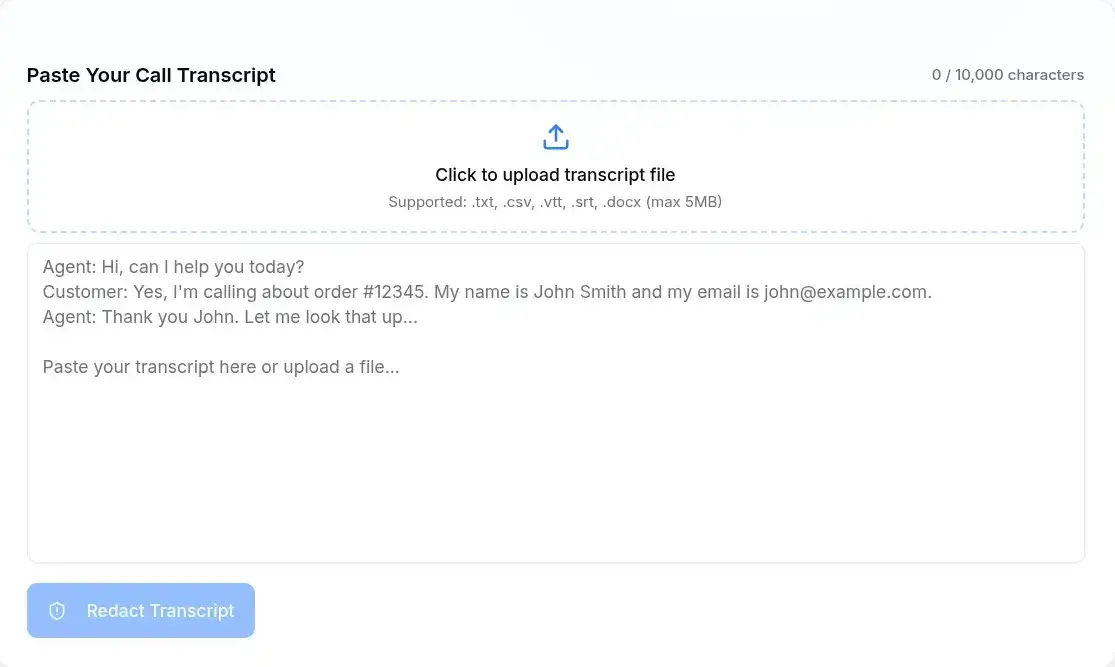 FoneSwift Call Transcript Redactor Tool
How it works:
- Visit /tools/call-transcript-redactor
- Paste your call transcript
- Click "Redact Transcript"
- Review the output
- Download or copy redacted version
What it redacts:
- PII: names, emails, phone numbers, SSNs, addresses
- Payment data: credit cards, account numbers, routing numbers
- Technical data: IP addresses
Limits:
- Up to 10,000 characters per transcript
- Free forever
- No sign-up required
- Manual, one-at-a-time processing
Example:
Input: "Hi Jennifer at 555-0147, ACC-4892156"
Output: "Hi [NAME_REDACTED] at [PHONE_REDACTED], [ACCOUNT_REDACTED]"
Time: <2 seconds
Enterprise Path: FoneSwift App with Advanced PII & PHI Redaction
Best for: Teams with 500+ calls per month, advanced compliance needs, or multi-department coordination.
Exclusive features in the app:
- Advanced PHI redaction: Medical record numbers, diagnosis codes, medication names, healthcare provider identifiers. Critical for healthcare contact centers and patient support lines.
- Custom redaction rules: Define your own patterns. If your industry uses unique identifiers, create patterns to catch them automatically.
- Bulk processing: Redact 1,000s of transcripts in minutes with API automation. Set it and forget it.
- Automated workflows: Call ends → Transcription completes → Redaction runs → Clean transcript exported. No manual steps.
- Retention policies: Auto-delete unredacted originals after X days. Redacted copies retained per your archive policy.
- Audit logs: See who accessed what, when, and why. Full compliance trail for regulators.
- Team collaboration: Multiple teams can access redacted transcripts safely. Unredacted versions locked to compliance officers only.
- Integration with your call system: Redaction happens automatically as part of your call recording workflow. No copy-paste required.
Example workflow in FoneSwift app:
Call 1: Healthcare patient calls
→ Automatically redacts: medical record #, medication name, provider name
→ Stores: clean version for QA, original (redacted) for 30 days only
→ Output: "Patient called about [MEDICATION_REDACTED] prescription refill"

Call 2: Sales call
→ Automatically redacts: SSN, credit card, account number
→ Stores: clean version for training, original purged after 72 hours
→ Output: "Customer interested in plan upgrade, approved for [AMOUNT_REDACTED]"
Pricing: Usage-based. 14-day free trial, all features included. No credit card required.
When to Upgrade to the App
Upgrade to FoneSwift app when:
- Volume grows beyond 500 calls/month: Manual redaction becomes a bottleneck
- You need PHI redaction: Healthcare, pharmaceutical, or medical device companies
- Multi-team collaboration: Different teams need different redaction levels
- Compliance audits are happening: Audit logs and retention policies are critical
- You want zero-touch automation: Redaction happens automatically, no manual steps
- Custom compliance requirements: Your industry has unique data types that standard patterns miss
ROI Example
Company: Tech support center, 2,000 calls/month
Without redaction (manual or unredacted storage):
- Manual redaction: 8 hours/week × $25/hour = $200/week = $10,400/year
- Risk of breach: Potential $500k+ liability
- Compliance audit failures: Legal costs, remediation
With FoneSwift redaction (free tool):
- 10 minutes setup
- 2 seconds per transcript (automated)
- Monthly: $0 (on free tool tier for pilots)
- Risk of breach: Minimal (redacted data is low-value target)
- Compliance audit: Pass with flying colors
With FoneSwift app (enterprise):
- 30 minutes setup
- Fully automated (0 seconds manual work)
- Monthly: ~$100-300 (depending on volume)
- Risk: Eliminated (auto-redaction + retention policies)
- Compliance: Full audit trail, automatic compliance
Annual savings: 8 hours/week × 52 weeks = 416 hours/year, or ~$10,000 in labor. Breakthrough on compliance: priceless.
Wrapping Up: Redaction as Risk Management
Call transcripts are treasure troves of customer insights. They're also loaded with sensitive data. Redaction isn't about hiding information; it's about separating what you need (call quality, techniques, outcomes) from what you don't (personal identifiers, financial data, medical information).
Build redaction into your standard workflow. Make it automatic. Review before sharing. Your compliance posture improves, your teams get the data they actually need, and your customers' privacy gets the respect it deserves.
The only question left is whether you redact proactively or reactively after a breach. The smart money is on proactive.
Next Steps
Start free today: Paste a redacted sample into FoneSwift's Call Transcript Redactor. See what patterns get caught. Test it on your actual transcripts. No sign-up, no credit card.
Scale to the app: When you're ready for automation, analytics, PHI redaction, and team-wide compliance, start your 14-day free trial of the FoneSwift platform. All advanced features included. See how redaction fits your workflow.
Questions? Schedule a demo with our team. We'll show you how contact centers just like yours use FoneSwift to stay compliant, share data safely, and scale training and analytics.
Start redacting transcripts today. Your customers' privacy depends on it. Your compliance depends on it. Your peace of mind depends on it.
Enjoyed This Article?
Subscribe to get more insights on AI calling, VOIP, and contact center automation delivered weekly.