
Contact Center Cost Reduction: How AI Calling Cuts Costs ~40% (Realistic ROI)
AI calling is becoming a top lever for contact center cost reduction. This guide walks C-level leaders and contact center managers through a realistic ROI model, an implementation playbook, and a pilot plan so you can quantify, and validate, cost savings before broad rollout.
Reduce contact center costs by optimizing handle time, deflection, and automation — a practical ROI model and pilot plan to validate 30–40% savings.
Why this matters
Contact centers are an often-overlooked cost center. Small reductions in handle time, automation of routine calls, and improved routing compound quickly across thousands of monthly interactions. This article shows a realistic path — assumptions, math, and a pilot plan — to evaluate AI calling ROI with minimal risk.
Problem statement
Contact centers face pressure on three fronts: rising labor costs, higher customer expectations for speed/personalization, and increasing call volumes (voice + digital). Key pain points we address:
- High cost-per-call driven by agent hourly rates and lengthy handle times.
- Repetitive, predictable call types (billing, status checks) that are high-volume and low-complexity.
- Inefficient IVR handoffs, long queue times, and uneven agent utilization.
Typical assumptions (baseline)
- Monthly call volume: 100,000 calls.
- Average handle time (AHT) baseline: 7 minutes (includes talk + wrap).
- Fully loaded agent cost: $20 / hour (salary + benefits + overhead) — replace with local cost.
- Automation target: deflect or automate 30% of calls, reduce AHT on remaining calls by 25%.
Short bullets — implications:
- Each 1% reduction in AHT yields meaningful monthly labor savings at scale.
- Automation reduces repeatable work and frees senior agents for complex issues.
- Pilot validation reduces the rollout risk: measure automation accuracy, containment rate, and CSAT.
Key insights and ROI model
The simplified ROI model calculates labor savings from two levers:
- Call deflection / containment — calls handled entirely by AI calling (no live agent).
- AHT reduction — automated assistance shortens live-agent time on partially handled calls.
Core formula (monthly savings)
Monthly Savings = (Deflected Calls * Cost_per_Call) + (Remaining Calls * AHT_Reduction_minutes/60 * Agent_Cost_per_Hour)
Where:
Deflected Calls = Total Calls * Deflection_RateRemaining Calls = Total Calls - Deflected CallsCost_per_Call = AHT_baseline_minutes/60 * Agent_Cost_per_Hour(baseline cost)
Sample ROI calculation (realistic example)
Assumptions:
- Total Calls = 100,000 / month
- AHT_baseline = 7 min
- Agent Cost per Hour = $20
- Deflection Rate = 30%
- AHT reduction on remaining calls = 25% (i.e., from 7 min → 5.25 min)
Calculate baseline cost:
Baseline Cost per Call = 7 / 60 * 20 = $2.3333
Baseline Monthly Cost = 100,000 * 2.3333 = $233,333
Deflected calls and savings:
Deflected Calls = 100,000 * 0.30 = 30,000
Savings from Deflection = 30,000 * 2.3333 = $70,000
AHT reduction on remaining calls:
Remaining Calls = 70,000
AHT_reduction_minutes = 7 - 5.25 = 1.75 minutes
Savings_from_AHT = 70,000 * (1.75/60) * 20 = 70,000 * 0.5833 = $40,833
Total monthly savings = $70,000 + $40,833 = $110,833
Percent reduction:
% reduction = 110,833 / 233,333 ≈ 47.5%
Note: This simplified model produces a ~47% labor-cost reduction under optimistic assumptions. In practice, expect 25–40% with conservative targets and non-labor costs included.
Comparison table (Baseline vs. With AI Calling)
| Metric | Baseline | With AI Calling (30% deflect, 25% AHT reduction) |
|---|---|---|
| Monthly Calls | 100,000 | 100,000 |
| AHT (min) avg | 7.0 | 5.25 |
| Agent cost / call | $2.33 | $1.16 (effective) |
| Monthly labor cost | $233,333 | $122,500 (approx) |
| Monthly savings | — | $110,833 |
| % labor cost reduction | — | ~47.5% |
How we measured (assumptions & sources)
- Data sources: internal benchmarking, industry averages for AHT and agent fully-loaded costs, and conservative containment rates derived from enterprise pilots.
- Key assumptions: deflection rate and AHT reduction are primary drivers. We assume no immediate headcount reduction in early months; savings are realized via reduced overtime, slower hiring, and improved utilization.
- Measurement method: compare baseline monthly labor cost vs. post-automation labor cost using the simple formulas above; include implementation and per-call AI costs to compute net ROI during a full business case.
- Sensitivity: model tested across deflection 15–35% and AHT reduction 10–30% to produce a realistic band (25–40% typical in our assessments).
Step-by-step playbook / best practices (implementation checklist)
-
Discovery (2–3 weeks)
- Inventory top 10 call intents by volume and handle time.
- Collect call recordings, transcripts, and IVR logs for training.
- Define success metrics: containment rate, AHT, CSAT, transfer rate, and cost-per-call.
-
Design (2–4 weeks)
- Map conversation flows for the top intents.
- Decide containment criteria — when the AI should resolve vs. escalate.
- Create fallback and escalation policies to ensure smooth handoffs.
-
Build & Train (4–8 weeks)
- Train models on historical data, tune NLU for intent accuracy.
- Implement dual-run for safety: AI suggests responses while agents supervise.
- Integrate with CRM for context (no vendor names referenced).
-
Pilot (4–8 weeks)
- Scope: 10–25% of calls (high-volume, low-complexity intents).
- Metrics to monitor daily: containment rate, transfers, AHT, CSAT, false escalation.
- Iterate weekly on prompts, intents, and escalation thresholds.
-
Scale (3–6 months)
- Expand to additional intents and languages based on pilot success.
- Introduce agent coaching insights from AI transcripts.
- Begin workforce plan adjustments (reallocations, reskilling).
-
Run & Optimize (ongoing)
- Quarterly reviews: update intent models and performance tuning.
- Use analytics to reduce repeat calls and improve first-call resolution.
Implementation checklist (condensed)
- Top-10 intents inventory
- Transcripts & audio dataset
- Baseline metric collection (AHT, CSAT, cost-per-call)
- Pilot scope & monitoring dashboard
- Escalation and fallback design
- Weekly pilot cadence for iteration
Sample call script (AI-assisted first contact)
Context: Billing balance inquiry; customer verified via last 4 digits.

AI: "Hello, this is [Company]. I can help with your billing balance. Can I confirm the last 4 digits of your account number?"
Customer: "1234"
AI: "Thanks — I see your current balance is $84.72 and the next due date is Oct 25. Would you like me to walk you through payment options or connect you with billing?"
If customer asks for payment: AI provides secure link via SMS/email and confirms completion.
If customer asks for agent: AI escalates with context summary: "Customer verified, balance $84.72, requested payment help."
Use this script in dual-run mode: AI handles the flow while an agent monitors during pilot.
Pilot flow - AI containment & contextual escalation
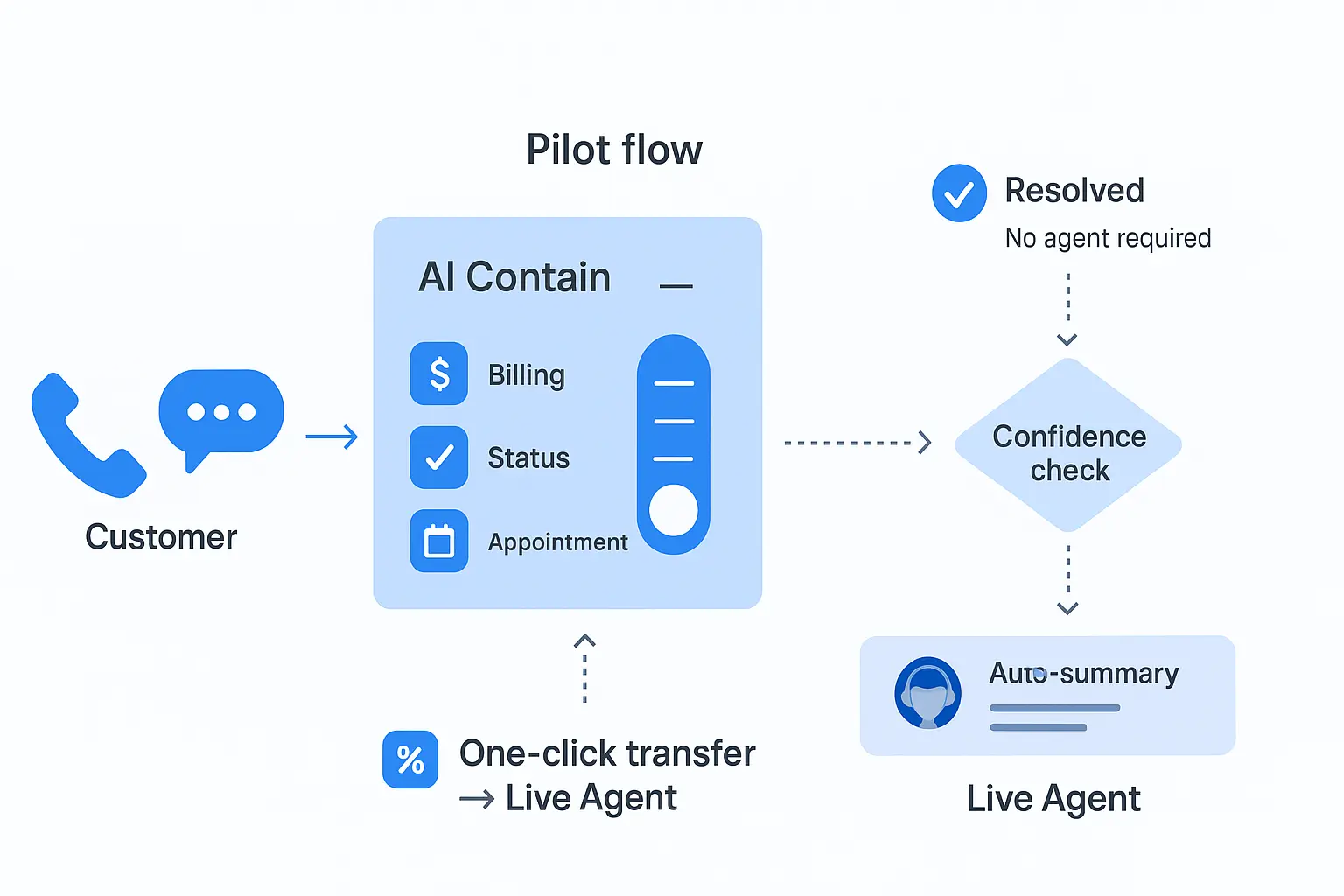
Caption: Pilot flow for AI calling — AI contains simple, high-volume intents end-to-end, runs confidence checks, and performs a one-click transfer to a live agent with an automatic context summary and hold-time minimization.
Risks & mitigation
-
Risk: Incorrect containment (false positives) Mitigation: Start with conservative containment rules and dual-run monitoring.
-
Risk: Customer dissatisfaction from poor voice UX Mitigation: Keep conversations short, confirm intent clearly, and escalate quickly when confidence low.
-
Risk: Data privacy/regulatory concerns Mitigation: Ensure PII masking, consent recording policies, and compliance checks before live rollouts.
-
Risk: Integration complexity with legacy CRMs Mitigation: Use phased integration (read-only context first), then enable writeback when validated.
Sample pilot plan (practical 6-step plan)
-
Scope (Week 0–1) — Select 2–3 high-volume, low-complexity intents (billing, status checks, appointment reminders). Define pilot KPIs: containment ≥ 25%, AHT reduction ≥ 15%, CSAT delta ≤ -0.5.
-
Prep (Week 1–3) — Collect data, configure monitoring dashboards, and train initial models.
-
Dual-run (Week 4–6) — AI runs in shadow mode; agents see AI suggestions. Track accuracy and handoff quality.
-
Limited live (Week 7–10) — Route 10–25% of target intent calls to AI with agent backup. Monitor containment, transfer rate, and CSAT.
-
Iterate (Week 11–14) — Tune prompts and escalation thresholds; fix edge-case flows.
-
Decision point (Week 15) — Evaluate success: if KPIs met, expand scope incrementally; if not, continue optimization or roll back.
Success criteria
- Containment ≥ 25% for targeted intents
- Net labor cost reduction vs. baseline ≥ 20% in month 2 of live pilot
- CSAT neutral or improved
Sample ROI sensitivity (quick reference)
| Scenario | Deflection | AHT reduction | Estimated labor reduction |
|---|---|---|---|
| Conservative | 15% | 10% | ~20–25% |
| Realistic | 25% | 20% | ~30–40% |
| Optimistic | 35% | 30% | ~40–50% |
Conclusion
AI calling can materially reduce contact center labor costs when implemented with a clear pilot, conservative containment rules, and a continuous improvement cadence. Start with the high-volume, low-complexity intents and validate economic assumptions during a short, well-instrumented pilot.
Start a free trial — get hands-on experience with AI calling and see how it can fit into your contact center operations. 14-day free trial, no credit card required.
If you'd like a customized ROI model built from your call logs, contact our team or upload a sample dataset and we'll scope a pilot plan tailored to your operations.
Further Reading
- Migration guide for contact center automation — planning & architecture.
- AI IVR case study — real-world pilot learnings and metrics.
- Scaling Contact Centers with AI: A Practical Guide — strategies for growth and efficiency.
Enjoyed This Article?
Subscribe to get more insights on AI calling, VOIP, and contact center automation delivered weekly.